 Rieden am Forggensee: Forggensee
The landscape around Rieden is an open pre-Alpine mosaic of pasture and lake shore, which has shaped both the built environment and local life. Rieden lies on the eastern side of Forggensee, an artificial lake in Bavaria’s Ostallgäu district, beneath the foothills of the Ammergau Alps. The reservoir was created in the 1950s to regulate the Lech and generate hydroelectric power; it is also Bavaria’s largest reservoir by surface area. Fields and farmsteads remain integral to the settlement pattern, while the lakeside links Rieden closely with nearby Füssen. This is the country of the Königswinkel, a region associated with Ludwig II’s castles, including Neuschwanstein and Hohenschwangau.
Generated by AI
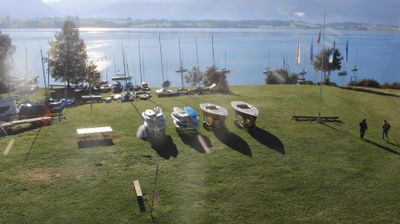

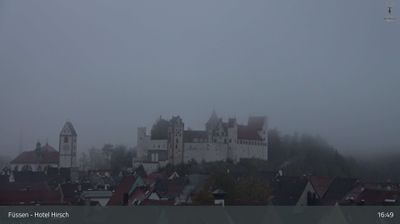

Few communities in Bavaria have a history as closely tied to the postwar construction of the Forggensee reservoir as Rieden am Forggensee. On the lake’s eastern shore in the Allgäu, the settlement faces water impounded from the Lech, with the northern Alps beyond the lake’s southern end. Forggensee was first filled in 1954 and serves flood-control and hydropower purposes; its winter drawdown remains a defining seasonal rhythm here. The royal castles of Hohenschwangau and Neuschwanstein stand near the lake’s southern reaches, connecting Rieden to one of Bavaria’s best-known cultural landscapes. See how Rieden am Forggensee fits into the wider Allgäu by browsing webcams nearby.
2 webcams
Built around the early medieval Duchy of Bavaria, Bavaria grew into Germany’s largest federal state. The Danube crosses its broad centre, while the Bavarian Alps form its southern edge and include the Zugspitze, Germany’s highest mountain. Munich is the state capital and the home of Oktoberfest, a festival rooted in an 1810 royal wedding. Beyond the metropolis, Franconia’s vineyards, Swabian towns and Alpine resorts reveal how varied this part of Germany can be. Browse additional webcams from the surrounding area to extend your view of Bavaria.
880 webcams
Germany stretches from the North Sea and Baltic Sea coasts to the Alps on its southern border, encompassing northern plains, river valleys and forested uplands. The Rhine, Danube and Elbe have long connected its regions, while the Black Forest and Bavarian Alps give the south a more dramatic relief. Berlin’s Brandenburg Gate and Museum Island reflect the capital’s role in German history and culture. Cologne Cathedral, a UNESCO World Heritage Site, rises above the Rhine, and the Bauhaus movement, founded in Weimar in 1919, transformed modern design far beyond Germany. Regional cooking, Christmas markets and brewing traditions bring further character to daily life. Browse additional webcams from the surrounding area to extend your view of Germany.
2.8K webcams